Two-day Training for the Council Officers/Focal Persons of Federal Ministries (BPS 17-19)
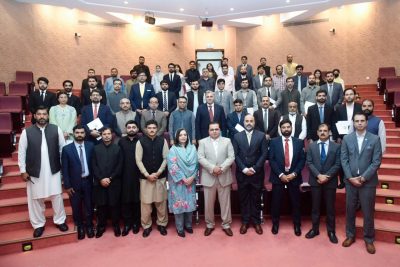
The Pakistan Institute for Parliamentary Services (PIPS) successfully organized a two-day capacity-building programme titled “The Legislative Journey of a Private Member’s Bill” from 29–30 July 2026 at the PIPS, Islamabad. The programme brought together Council Officers/Focal Persons (BPS 17–19) from Federal Ministries and Divisions to enhance their understanding of Pakistan’s legislative framework and strengthen their capacity to effectively process, examine, and coordinate matters relating to Private Members’ Bills.
The programme commenced with the recitation of the Holy Quran, followed by a programme overview by Director General (Capacity Building & Development). She briefed the participants on the objectives, structure, and expected learning outcomes of the two-day training.
This was followed by the welcome remarks of Mr. Asim Khan Goraya, Executive Director, PIPS, who emphasized that effective legislation was the cornerstone of democratic governance. He highlighted the pivotal role of Parliament in the law-making process and underscored the growing significance of Private Members’ Bills in promoting inclusive policymaking, strengthening parliamentary oversight, and fostering responsive governance. He further reiterated PIPS’ commitment to equipping parliamentary and government officials with the knowledge and skills required to effectively support the legislative process.
The first technical session was conducted by Barrister Syed Qamar Hussain Shah Sabzwari, Advocate Supreme Court and Legislative Expert, who provided participants with a comprehensive overview of Pakistan’s legislative system. His presentation focused on the constitutional framework for legislation, the distribution of legislative powers, and the role of Parliament in the law-making process.
Expanding upon the constitutional foundations discussed earlier, Mr. Muhammad Azam Sulehri, Deputy Secretary (Legislation), Senate of Pakistan, delivered an in-depth presentation on the legislative journey of a Private Member’s Bill. The session comprehensively covered the distinction between Government and Private Members’ Bills, the procedure for introducing a bill, the stages of parliamentary consideration, the role of parliamentary committees, passage through both Houses, Presidential assent, and the constitutional provisions governing the continuity of bills.
Concluding the proceedings of the first day, Sheikh Sarfaraz, Legislative Expert, led a practical session on the role of the Federal Government in processing Private Members’ Bills. Through the examination of actual legislative proposals, participants developed a clearer understanding of the responsibilities of ministries, inter-ministerial consultations, preparation of ministerial comments and recommendations, and the coordination required among key government institutions during the legislative process.
The technical proceedings on the second day commenced with a session by Mr. Jam Muhammad Aslam, Additional Draftsman, Ministry of Law and Justice, who examined the significance of legislative oversight and the committee scrutiny of bills. Drawing upon practical examples, he highlighted the role of parliamentary committees in ensuring accountability and improving the quality of legislation.
Subsequently, Mr. Muhammad Mushtaq Ahmed, Advisor on Legislative, Parliamentary Proceedings and Training, National Assembly Secretariat, delivered a comprehensive session on the committee stage and parliamentary proceedings. The discussion focused on effective participation in committee meetings, responding to committee recommendations and proposed amendments, and the role of public hearings in promoting transparency, stakeholder engagement, and informed parliamentary deliberations.
The final technical session of the programme was conducted by Mr. Mohsin Abbas Syed, Legislative Expert, Ministry of Defence, who addressed the follow-up responsibilities of ministries after the passage of a bill. The session culminated in an interactive practicum on the substantive review of a Private Member’s Bill, enabling participants to apply the concepts and practical skills acquired throughout the two-day training.
The two-day training concluded with the Vote of Thanks by Ms. Samer Awais, Director General (Capacity Building & Development). In her closing remarks, she thanked the distinguished resource persons for sharing their expertise and appreciated the active participation and engagement of the participants throughout the programme.